Architects
Open To Sky
Completion
2026
Photos
Gokul Rao Kadam
Illuminating the Art of Atmosphere
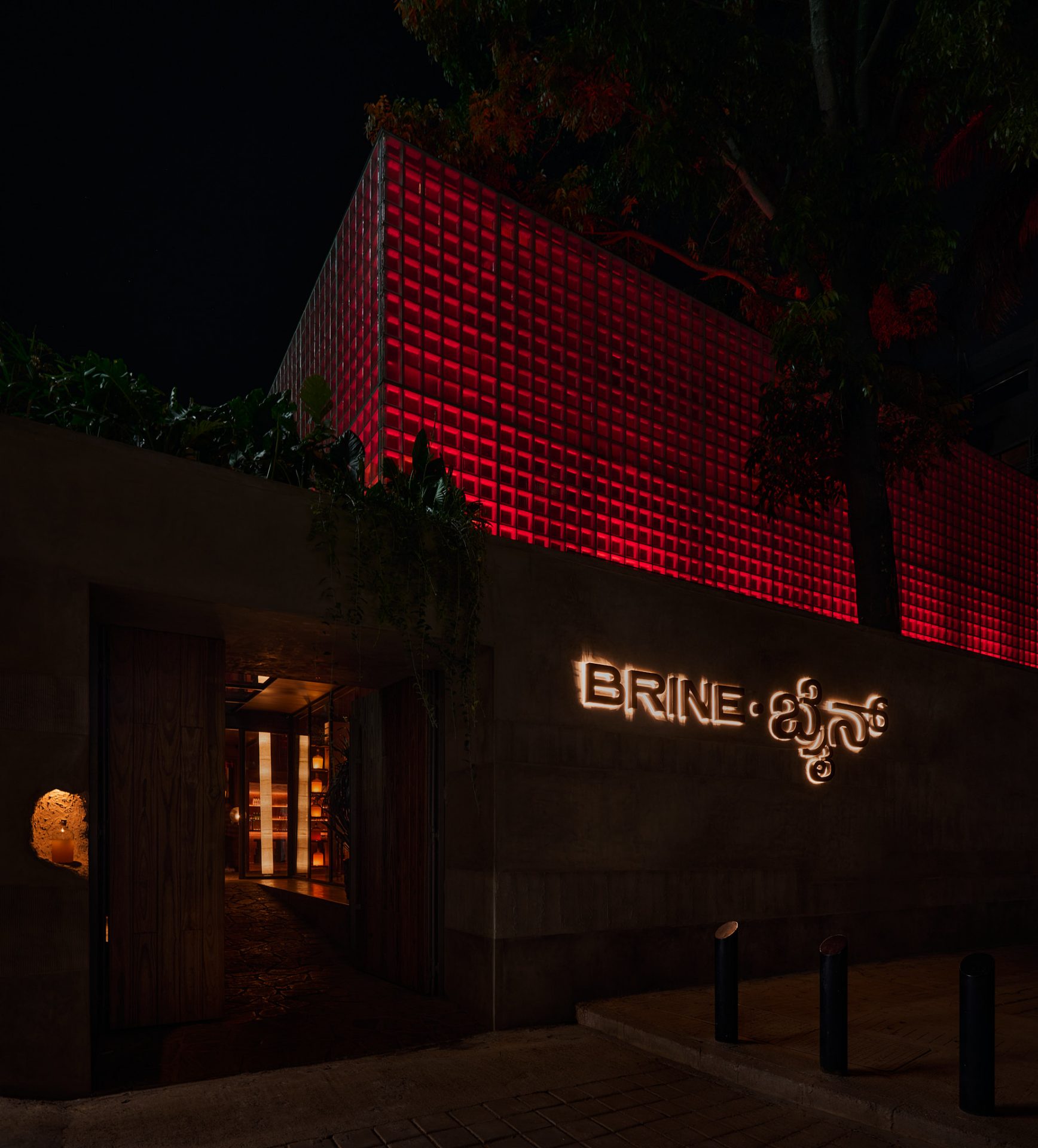
The brief began with the architecture. George Seemon of STAPATI designed a steel-and-glass volume onto a residential footprint, a material language rarely seen in Bengaluru, and one that reads as genuinely radical for the area. The glass-brick volume behaves differently across the day: in daylight, its partial translucency lets it recede into the streetscape. At night, the intent reverses entirely. We wanted the building to become an invitation, not a curiosity, something people see and are drawn toward, rather than something they merely notice and wonder about.
Making that happen meant making the glass itself glow, which isn’t straightforward, glass doesn’t naturally hold or catch light. After testing several options, transparent, lightly textured, more heavily textured, and translucent, together with the architect, we chose a glass with just enough texture to scatter light without making the façade visually busy. A line of linear grazers mounted on the inside washes light across the glass bricks, so from the street the glow reads as continuous and ambient rather than as a row of visible fixtures. Several studies and mock-ups went into this, not just to illuminate the glass brick itself, but to find the right hierarchy of light within it: the right balance of highlight and shadow, so the façade had depth rather than a flat, even glow. The harder discipline was containing that same light, keeping it confined to the façade plane, with no spill into the human-scaled ambience inside.
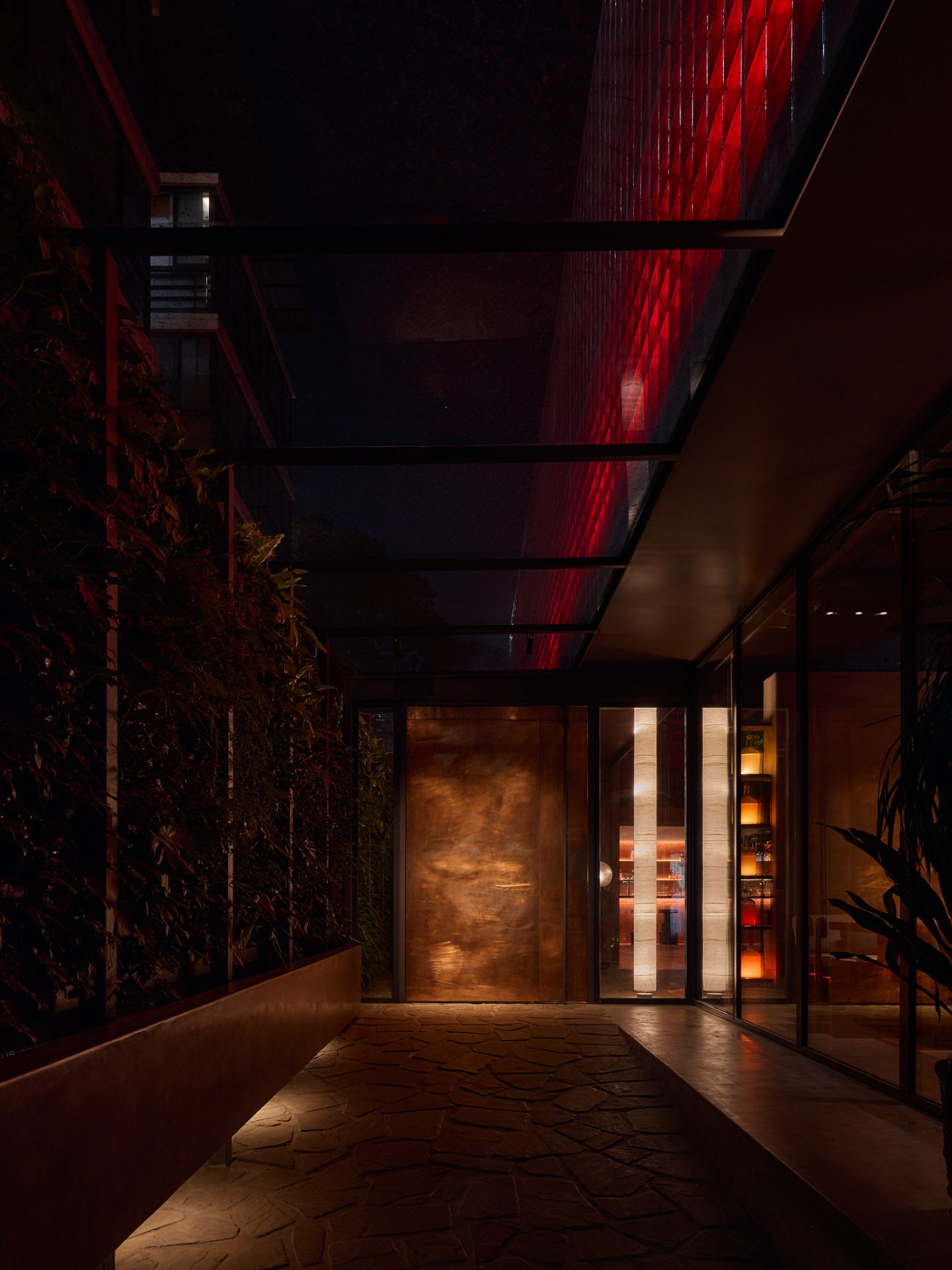
Inside, the material palette – polished copper against rough, warm concrete, designed by Animesh Nayak of Open to Sky gave us a tactile pairing to design light against. The sequence begins at a bold copper door, met by two projectors trained precisely on its surface, light shaped tight enough to find the grain of the metal, not wash over it. Everything else along the approach stays quiet, so the door arrives first, and arrives certain.
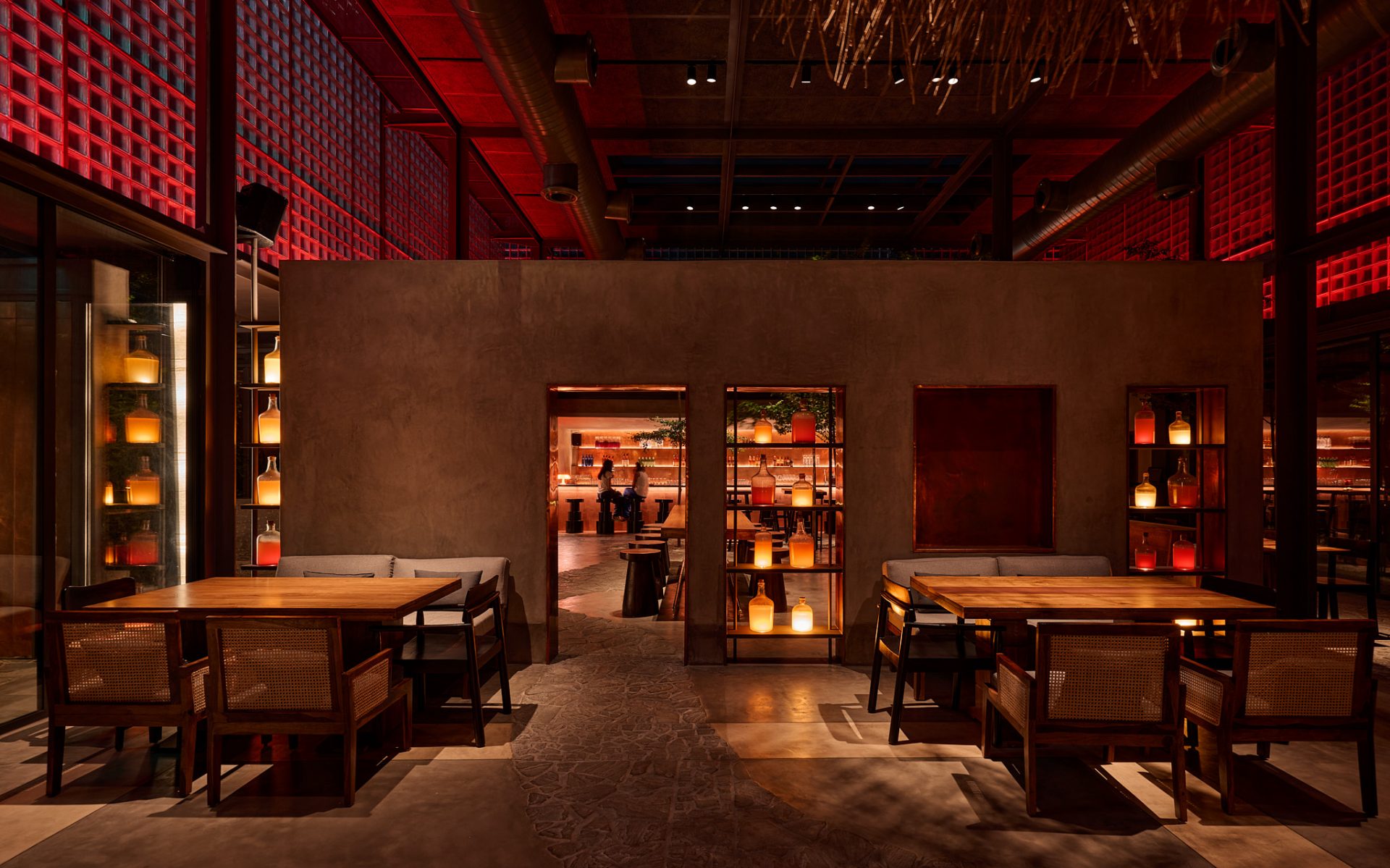
Beyond it, the room opens into a soft, double-height volume, eased further by planting and trees.
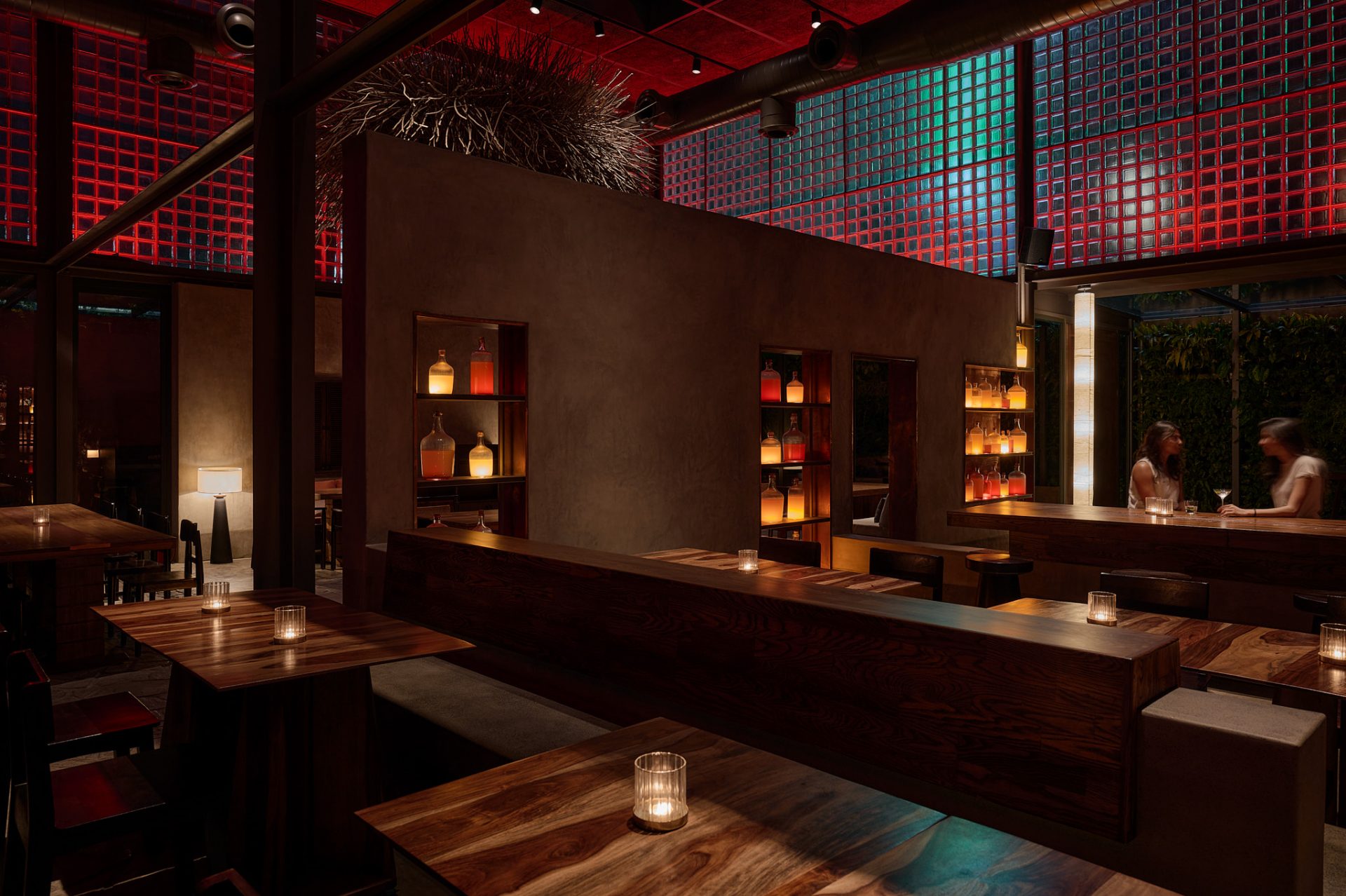
From here, light is governed by hierarchy. With a cuisine-agnostic menu sending unpredictable colours, textures, and drinks to the table, illumination on countertops and tabletops became paramount. This was achieved with ceiling-mounted projectors using narrow-beam optics – light pulled tight enough to land precisely on the tabletop with almost no spill beyond it. Getting there took extensive mock-ups; the market in Bangalore, and India more broadly, offered limited options precise enough for what the brief demanded.
The bar itself works on concealment rather than display. The copper face and the bottles behind it appear to glow on their own, there is no visible source, no fixture to trace back to. You see the reveal, never the reveal’s origin. At the serving counter, a punch of light meets the glass the moment the bartender sets it down, enough to make the drink look its best the instant it arrives, without that light reading as a separate effect.
So light stays low and human-scaled throughout, built on one simple idea: a bar should make people look good for each other. That’s what brings them back, or brings them back with someone new. The few tables set beneath the trees carry this furthest, light filtering through the canopy creates a dappled pattern across the tabletops, making it one of the most atmospheric seats in the room.
Across the volume, opposite the high bar-side seating, the lounge takes a different posture. Where the bar side stays social, active and busy, the lounge brings in floor lamps, a domestic gesture that softens the register and signals: sit back, stay a while.
Outdoors, the register shifts again. A linear strip of exterior lighting marks the smoking and more intimate outdoor zone, deliberately kept low, enough for safe navigation and facial recognition at close range, but dim enough to feel exclusive and apart from the main room.
And finally, true to the bar’s name, jars of live brine are placed through the space, each softly lit. This light carries no functional purpose, it’s mnemonic, meant to leave a small visual imprint tied to where someone sat, a trace of the Brine experience that lingers after they’ve left.
Every choice here was about restraint as much as glow. What to light, what to leave dark, what to let people discover on their own. That, in the end, is light, considered.